Neuro-Rodeo

Our minds maintain a persistent force field to prevent us from doing things we may later regret.
Anything we think about doing, any action we consider taking, any words we just might utter are held in check by a wall of inhibition.
When we do something, we are dropping a specific, localized section of our force field, releasing the action directly behind it.
Energy is required to sustain this force field. Selective disinhibition is the term used by neuroscientists to describe the delicate art of powering down part of our shield-wall with precision, allowing ourselves to do what we intend to do, when and where we intend to do it.
We do not have to exert energy to start doing something. Courage is required, however, to release actions from captivity.
To better understand this counterintuitive concept, let us first examine the real world phenomenon known as rodeo.
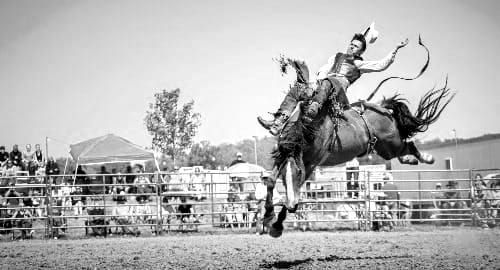
Imagine a circular arena surrounded by rows of bleachers filled with spectators. Outside of the arena, fences contain many large bulls, snorting, stomping and shuffling restlessly.
Corrals lead from the larger fenced areas into tightly fitted, individual pens located around the perimeter of the arena. In rodeo parlance, these single bull pens are knows as chutes, separated from the arena by closed, latched gates.
Under the supervision of the arena director and livestock coordinator, bulls are chosen and herded into these chutes, one by one.
Once in the chutes, the bulls are under the jurisdiction of the chute boss, who tells riders when to mount their assigned bulls. If the arena is clear and the rider is ready, the chute boss nods to the gate attendant, who “breaks the chute,” springing the gate wide open. Bull and rider promptly explode into the arena, and the fans go wild.
Bucking bull and clinging rider are judged on form and technique for up to 8 seconds, after which the rider, if not already in the dirt, attempts to dismount without being gored and hastily exits the arena. The bull is harassed by clowns until it leaves the arena as well, ending up back in the pens outside.
What does any of this have to do with the neuroscience of selective disinhibition? Quick answer: Everything.
Ideas float around in the outer layers of our brains, much like bulls in holding pens outside of the rodeo arena.
Under the supervision of our prefrontal cortices, or PFCs, the best ideas are corralled into slots to form a “potential action menu” from which the the basal ganglia, or BG can select possibilities, run them through its algorithms and choose the next right thing. When the coast is clear and the time is right, the BG drops inhibition in front of its chosen action plan, which is released onto the field of reality. Just like riders clinging to bucking bulls, the actions are judged, timed and cleared away as the dust settles.
We keep plenty of potential actions in a state of high readiness, held in place by inhibitory gating mechanisms. The timing and sequence of their release depends upon our immediate situations and long term goals.
There are several ways in which this system can malfunction.
At the rodeo, the livestock coordinator may send the wrong bulls into the chute. The chute boss might open gates in the wrong order, simultaneously, or not at all. The latches might be faulty, allowing the gates to open spontaneously. Rusty hinges impede opening and closing. Bulls without riders, clowns on strike, hungover judges, distracted timers - any one of these can trigger rodeo chaos.
Acting impulsively, starting and stopping without finishing, doing nothing when action is indicated or doing everything except what we intend to do - all of these can result from inconsistent feedback, rigid force fields and non-selective disinhibition.
Inside our brains, dopamine is the primary mode of immediate communication. A quick surge means “All good,” while a pause indicates something is amiss. With experience, consequences of our actions influence idea selection as well as the probability and timing of their release.
When we feel stuck, unable to take action despite fully intending to do so, our gates remain closed and latched. If other gates open too easily, we find ourselves doing things unintentionally. Frustrated and overwhelmed, we fling open several gates to shake things up. Imagine a rodeo arena crowded with angry bulls bucking around, knocking into each other, trampling riders who couldn’t hold on. Send in the clowns! Now imagine trampled clowns.
Obviously, the Undone loves when we’re stuck. It thrives on disorganization, miscommunication, unintentional consequences and dysfunctional force fields. Unfinished business is its primary power source.
With a little team building and preventative maintenance, we can improve the fluidity and reliability of our idea to action flow.
Basic, daily routines ensure the system is operational. Exercise opens and closes the gates repeatedly and lubricates the hinges. Sufficient sleep improves communication by replenishing dopamine reserves.
Even at rest, our minds hold pent up energy in the form of potential actions held back by closed, latched gates. At any given moment, our chutes are stocked with bullish ideas, ready to explode into reality.
To act with intention, we open one gate at a time, breaking the chute to release what we hope is the right action in that particular moment.
Riding an idea into action takes courage. When that gate opens, we hang on tight for as long as we can. After hitting the dirt, we exit with haste to avoid being trampled or gored. When the ride is over, we put that idea back in its pen or out to pasture.
When the dust settles and the crowd has gone home, any bulls left in the chutes ain’t done.